
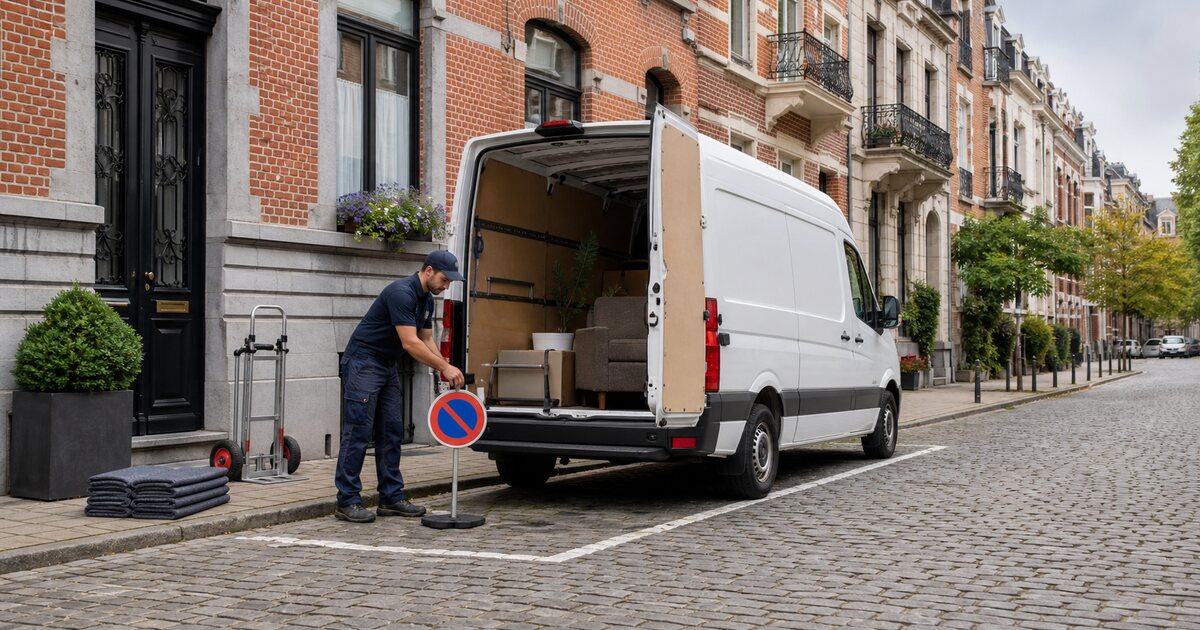
This is the most forgotten step, and the most expensive one on moving day. Without a reserved space outside the building, the crew carries your furniture fifty or a hundred metres: the move takes longer, and the invoice follows.
What it is
A temporary occupation permit for the public highway, often called a "parking permit" or "space reservation", bans parking on a few spaces, on a precise date and time, for the duration of loading or unloading. It takes the form of two prohibition signs placed on the pavement, showing the dates and times concerned.
It is issued by the municipality (mobility department, works department or local police, depending on the case). Every commune has its own procedure, its own lead time and its own fee: there is no single rule across Belgium.
You need two of them
If you are leaving one commune for another, the request is made to both: the one you leave and the one you arrive in. These are two separate files, with two lead times and sometimes two fees.
When to request it
Allow at least two to three weeks, more in large cities and in high season. Some communes accept later requests, others do not, and June to September is saturated.
The useful reflex: as soon as your moving date is set, search for "removal parking space reservation" followed by the name of your commune. Most communes now offer an online form.
What you will be asked for
- Your contact details
- The exact address and the number of metres to reserve (count 15 metres for a lorry, 10 for a van)
- The date and the time slot
- Sometimes the vehicle's number plate and a copy of the removal contract
Depending on the commune, the signs are supplied by the administration, collected and returned by you, or delivered on site by a service. The fee ranges from free to a few tens of euros. Check both points when you apply.
Put the signs up in time
In most communes the signs must be placed at least 24 hours before the reservation starts: check the lead time written on your permit, which is what counts. A sign put up the same morning cannot be enforced against a driver who parked the day before.
When placing them:
- check that the dates and times are correct and legible;
- photograph the signs in place, with a timestamp, and get the street in frame;
- note the plates of any cars already parked in the space.
Those photos are your only evidence if you need a vehicle removed.
And if a car parks there anyway?
It happens. If the vehicle was parked before the signs went up, it is within its rights and you will have to work around it. If it parked afterwards, it is in breach:
- Call the local police (not 112) and quote your permit number.
- Show your timestamped photos.
- The police record the offence and, depending on the case, have the vehicle moved or towed at the owner's expense.
Expect this to take time: one more reason to put the signs up early and to warn your neighbours of the date at both addresses.
Special cases
- Pedestrian zone, shopping street, weekly market: a specific permit and imposed hours often apply. Say so when you apply.
- Furniture lift: it takes up more ground space and must be mentioned in the permit.
- Street works or a building site next door: check the street will actually be accessible on the day.
Just tell us whether the street is narrow, one-way or in a blue zone: we will tell you how many metres to reserve and which department to contact in your commune.